
Lived Experience Interview:
Ellie Estrada — Ethics, Obligation, and Hope in Community-Focused Research
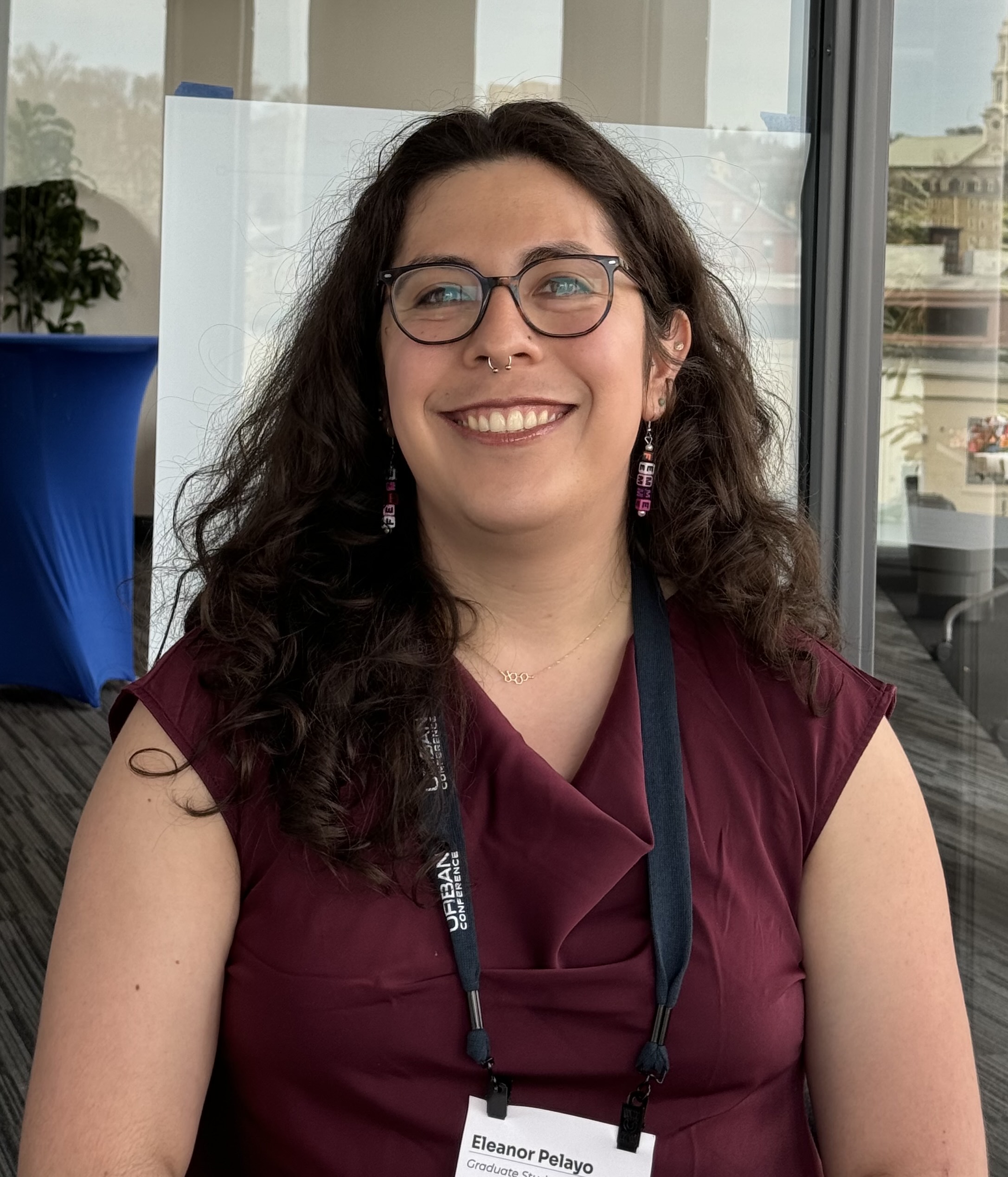
In this interview, conducted at the 2025 URBAN National Conference, Ellie Estrada discusses her research journey and connection to the Urban Research Network. She emphasizes the importance of understanding community through personal experiences, critiques extractive academic practices, and advocates for collaborative ethics/obligations to communities, and community-led review boards. Committed to diverse forms of practice, direct action, and hope in social change efforts. Ellie also reflects on the challenges of reconnecting with her identity identity and community, emphasizing the complexity and discomfort inherent in this process.
JCEC:
Can you tell me a bit about yourself, the work that you do, and how you ended up being connected to the URBAN Research Network?
Ellie:
I am Ellie Estrada and I come to the research with a sort of alienation that a caring embodied in me and I try to explore that in the research. In some ways, research is a way to understand myself by looking at communities that matter most.
So, I’m a first generation student. I identify as a Chicana feminist and I’m also a trans woman of color within the racialized particularities of Salt Lake City, which is mostly white folks, but mostly white folks within the Metropole area of Salt Lake. The communities that honestly mean a lot to me are the ones that are typically called the barrio communities. There is a racialized enclave history with them that was created by ways of infrastructural oppression, and those communities mean a lot to me.
I actually grew up in Southern California in a city called Westminster. And Westminster I knew, by virtue of its very tenuous relationship with divestment, like divestment that we would experience in, for example, schools. My school, at one point, had a moment where it primarily serviced Vietnamese populations and Mexican populations. My family is Mexican, so when I started going to school, I had noticed that there was actually this thing that happened where the school wanted to renovate, but instead of investing into the educational programs, they invested in, both figuratively and materially, repainting the bars. That particular metaphor stuck with me when I started approaching research, because then I saw education as not really a way out, but a deeper way in.
So, I started going to school as a better way of understanding how that investment and divestment took place within my own material life. I went to school for the purpose of understanding people like my mother’s stories, and I actually just realized that the more I read, the less I knew. That’s why I’m here at URBAN. It’s for the purpose of being able to speak to other community practitioners, activists, and even some scholars, for the purpose of understanding what their relationship to community is. It’s still kind of a process. It’s still kind of an “I’ll get this. I’m going to include the demon here.” It’s a navigation.
JCEC:
How do you tend to think about collaboration and what kinds of collaborative relationships or practices are you or your organization engaged in?
Ellie:
I think that word “collaboration” is a lot of things. The first word that comes up to me is “fraught.” There is already a resource relationship that we as practitioners (whether community practitioners or scholars) oftentimes assume within communities that we are from. And Max Levorion [E”E1.1] calls these “resource relations” that we develop where we view the knowledge as it materializes as a tangible resource. For academics, it comes in very familiar ways. We go to communities for a short amount of time. We become the drive-by scholar for two years, four years, or however long it takes to secure our resources. These extractive relationships create and form the visions of what it is that we know as “community,” because we have created this vision of it that we have now fit into this little box that we call “data.” Whatever form it takes, it is still data. And so I think a lot of the preservation of that data does very much appear in some of our collaborations with community, where we have to interrogate ourselves. First of all, why am I here in community? Why am I in a collaboration? I think that for community practitioners and people who are from within the community, those commitments do still exist. Those obligations still do exist. But I think that they look different than for someone who is in a historically violent place like academia.
I try to approach collaboration as being guided by two things. The first one is ethics. Frankly, I think that ethics needs to be more collaboratively done. When people talk about the co-production of research, I think that they actually need to start with ethics. For instance, the IRB Institutional Review Board… I think that people too often assume that IRB approval is the only approval that we need in order to study community. On the flip side, my dissertation project is an examination of conditions of gentrification as they are created through gossip or chisme in the west side in Salt Lake City. This is a project that, of course, receives IRB approval because academics need us, but I’m also receiving approval from the West Side Community Review Board — a localized community review board that is made up of residents, activists, and just generally, voices on the West Side who have been disenfranchised from the process and from the protocol itself. That, to me, is not the end point, but a start towards confirming ethics as being community related and co-created.
I guess the second thing is that collaboration must also be guided by obligation, borrowing from Max Lavorion [E”E2.1] again. Obligation is really to whom are you owing yourself? To whom are you owing the research? Because I think that, especially within academia, there is a sense of ownership that oftentimes gets obfuscated. We are not the owners of something because we are the first author of that paper. I think that we are not even the owners of the knowledge, in some cases, if we have chosen to capitalize on that knowledge. But on the flip side, the community owns that knowledge and so obligation to community is really just orienting your relationships and your sense of relationality towards community. I am doing this in the name of community. I am doing this, in this particular case, for my mom, who can’t be in these spaces. So, I think that that’s where I get back to: collaboration must be guided by ethics and obligation.
JCEC:
Based on your experience, what would you say are some collaboration-best-practices that you would suggest others use in their collaborative relationships — particularly in this current context of great social upheaval and uncertainty?
Ellie:
Practices take so many different forms, so I guess the first thing is to understand that there are manifold ways of understanding practice. There are spiritual practices. There are material practices. There are, in some cases, practices that are much more attuned to the environment. And so I think making room for the different forms that practices take is a really good way of actually making sure that your practices are oriented toward the different forms that takes place in community. So, for example, I was speaking to one of my peers who is a community practitioner at Utah, and we were talking about how dissemination takes so many different forms. In some cases, dissemination literally looks like a recipe book, especially for decolonial food systems. And so, I think that understanding that practice is going to look differently for communities as it will for individuals is super important.
Number two: accounting yourself to your obligations. I think that obligations means that you have to think about, “Where exactly am I from? Where am I going? Who are the people that are coming with me?” I think that a lot of people are very familiar with the trope of certain people who, when taken out of their communities, feel themselves alienated from the work to the point where their own streets don’t even recognize them. I very much am speaking to this particular vibe, because it feels like that sense of alienation is carried with us wherever it is that we go. As a means of returning and even just reconciling those relationships, I think that those obligations need to be spoken to.
Number three: direct action works. I think that in terms of best practices, we err on the side of a lot of prescriptives and a lot of imperatives. These are things that establish very necessary visions, to be fair. But the problem is they stop there at the visions. To borrow a bit from Jose Muñoz when he writes about “Cruising Utopia,” he says that utopia is really in the here and now. He is hyper aware of how people criticize utopia as being utopic. I think that the realization of the here and now means that we have to understand that we’re pushing ourselves towards very particular futures. The reason that, for example, Palestinian encampments work, the reason that direct action works is really just because it is a necessary confirmation of the here and now through a stubbornness to refuse to not exist anymore. In a sense, it is pushing back and saying, “We actually don’t just deserve to have a future, but the future is realized in the present.”
And number four: hope. I think hope is really generative and really radical and practicing the very particular ways that we carry hope and inspire other people is really good because it sucks, especially in damage-centered research, for communities to believe themselves as being broken or damaged or harmed. As a means of returning justice to those very communities, we have to understand that hope can take us away from damage-centered research and maybe just a general force. I’m gonna leave it at force, because we don’t know what it is.
JCEC:
Is there anything you would like to add?
Ellie:
So, everything is about refusing prescriptives and stuff like that. Here’s another one… I’m thinking about when I entered the URBAN space a couple of months ago — a year and a half ago, actually. My advisor had encouraged me to engage in more Urban Communication Studies-type research. My home field is actually Communication Studies and within that broader field there are so many sub disciplines it is impossible to count them all. So, when I entered into Urban Communication Studies, I thought about the dynamics of having to tokenize myself, for example, as a trans woman in a space that is not usually known for being centered around queer orientations. So, the other thing that I’ll add is that how our bodies perform in some of these spaces still very much matters. How our communities are shaped around that still very much matters. I am really vibing with the whole process of reconnection because reconnection, to me, means not just reconnecting to place, but also reconnecting to what does it actually mean to be, for example, a Chicana feminist in practice? What does it mean to be a trans woman trying to reconnect with barrio? It just means that there’s a lot of additional obstacles in the way, and that means that reconnection is actually a very complicated and a very uncomfortable process, in some cases. Maybe the last thing I would leave with is that my own current obligations are guided by a sense of reconnection and I’m hoping that reconnection could be “troubled.” Also, the food around here has been really good. So, I appreciate very much Rhode Island and all that it has provided!