
Lived Experience Interview:
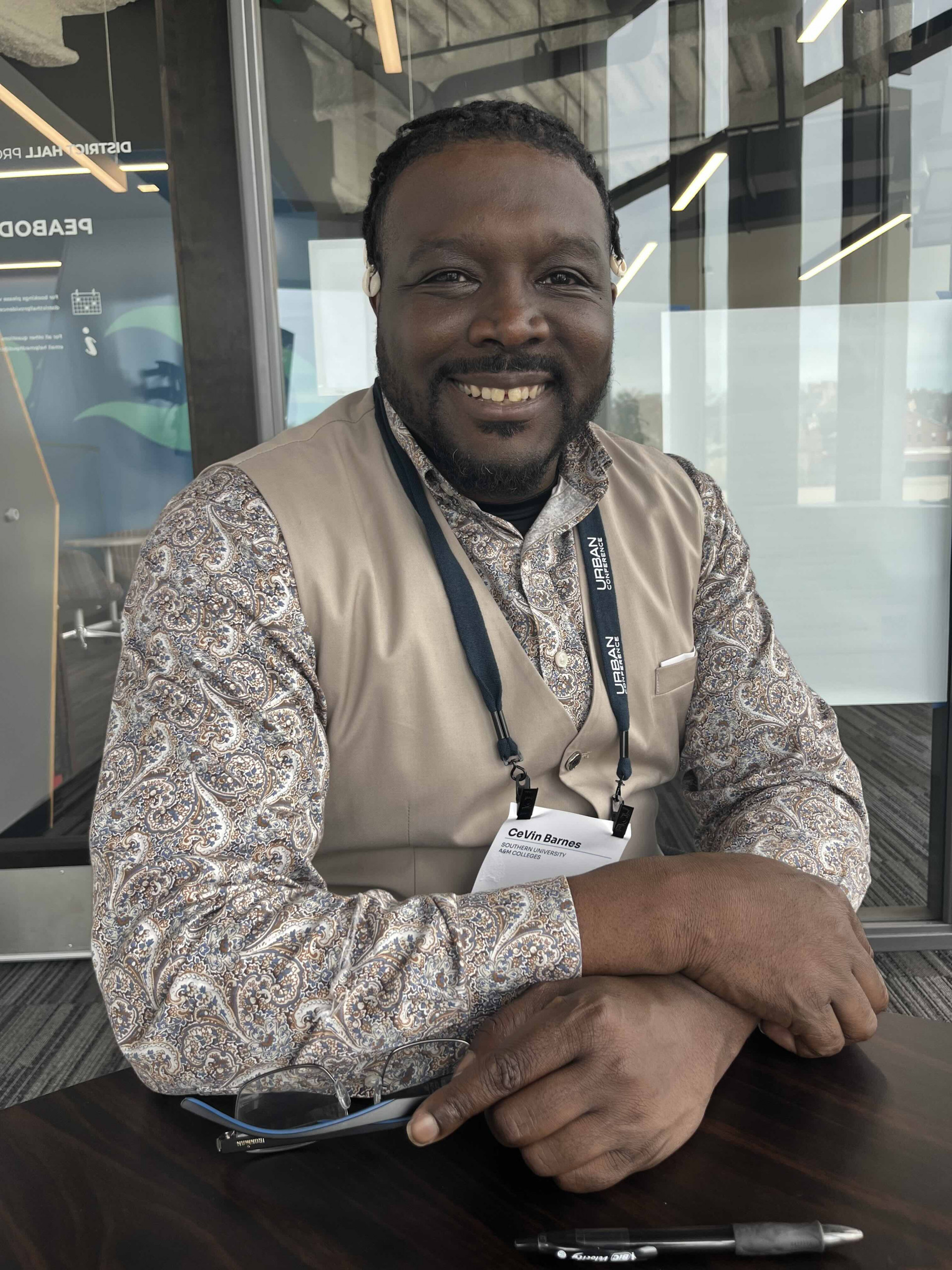
Dr. Ce’Vin Barnes — U.S. Army Veteran, Civic Leader, Scholar
In this interview, conducted at the 2025 URBAN National Conference, Dr. Ce’Vin Barnes reflects on leadership, collaboration, and the future of urban communities and HBCUs. His journey from U.S. Army officer to civic leader and scholar offers a perspective that blends service, resilience, and purpose.
JCEC:
Can you tell me a bit about yourself, the work that you do, and how you ended up being connected to the URBAN Research Network?
Ce’Vin:
I am a U.S. Army veteran who proudly served ten years, including five deployments to Iraq and Afghanistan in support of the Global War on Terrorism. My academic foundation is rooted in two great HBCUs—Grambling State University and Southern University and A&M Colleges, where I earned my PhD in Public Policy and Urban Affairs from the Nelson Mandela College of Government and Social Science. My research focused on the Impact of Exclusionary Disciplinary Practices Impact on Minority Students in Urban School Districts.
My professional and civic journey has always been centered on service. Whether volunteering with the American Legion’s, Veterans of Foreign Wars (VFW), Wounded Warriors Program, Lions International (Von Braun Lion Club), or serving as Vice President of the Huntsville–Madison County NAACP Branch 5034, I’ve seen firsthand how leadership can shape lives and strengthen communities. I also chair the Emergency Response Committee at the Alabama State Conference of the NAACP, ensuring our communities are equipped to respond to crises.
My connection to URBAN began through a classmate who introduced me to Dr. Tim Eatman. That introduction opened the door to a network where scholars, practitioners, and advocates collaborate monthly, sharing research, ideas, and strategies. My first engagement was in August 2024, and since then I’ve remained deeply involved in projects that fuse scholarship with community impact.
JCEC:
How do you tend to think about collaboration and what kinds of collaborative relationships or practices are you or your organization engaged in?
Ce’Vin:
For me, collaboration is rooted in one simple truth: “Everybody wants to operate, but not too many want to cooperate.” True collaboration demands that we put egos aside and recognize that each of us brings unique gifts that, when combined, can transform communities.
Collaboration is teamwork—but deeper than that, it’s trust and confidence built over time. When disaster struck Alabama recently, I worked with the American Red Cross and United Way to deliver relief after devastating tornadoes. That effort required planning, coordination, and humility. At the end of the project, we didn’t point fingers; instead, we asked, ‘How can we get better?’ That mindset not only improved disaster response but built credibility with residents and stakeholders who now trust us with their support and resources.
Collaboration, then, is not just about getting the job done. It’s about creating a culture of accountability, humility, and shared success—principles that apply as much to research and higher education as they do to disaster relief.
JCEC:
Based on your experience, what would you say are some collaboration best practices—particularly in this current context of social upheaval and uncertainty?
Ce’Vin:
My philosophy is mission first, people always. Personalities and conflicts will always arise, but we cannot lose sight of why we came together in the first place. Collaboration begins with clarity of mission and respect for the people who advance it.
If I were to distill my advice into three best practices, it would be these:
– Communicate with clarity and patience. People don’t just remember what you said, they remember how you treated them.
– Develop resilience. You will encounter criticism, impatience, and competing interests. Thick skin and humility are essential.
– Center service, not self. None of us are the ‘star.’ Our communities are the focus, and they expect answers, action, and authenticity.
In my military deployments, I learned the importance of cultural humility. Entering communities in Iraq and Afghanistan, I had to set aside my assumptions and instead meet people shoulder to shoulder—what we called Shauna BiShauna. That phrase meant, ‘I walk with you, not ahead of you.’ The same principle applies today. Collaboration is not about imposing solutions; it’s about building them together, with respect and humanity.
Ultimately, collaboration is less about patching leaks and more about learning how to weather storms together. In a time of upheaval, what people need most is not perfection, but trust, consistency, and leaders who will stand shoulder to shoulder with them until the work is done.