
Lived Experience Interview:
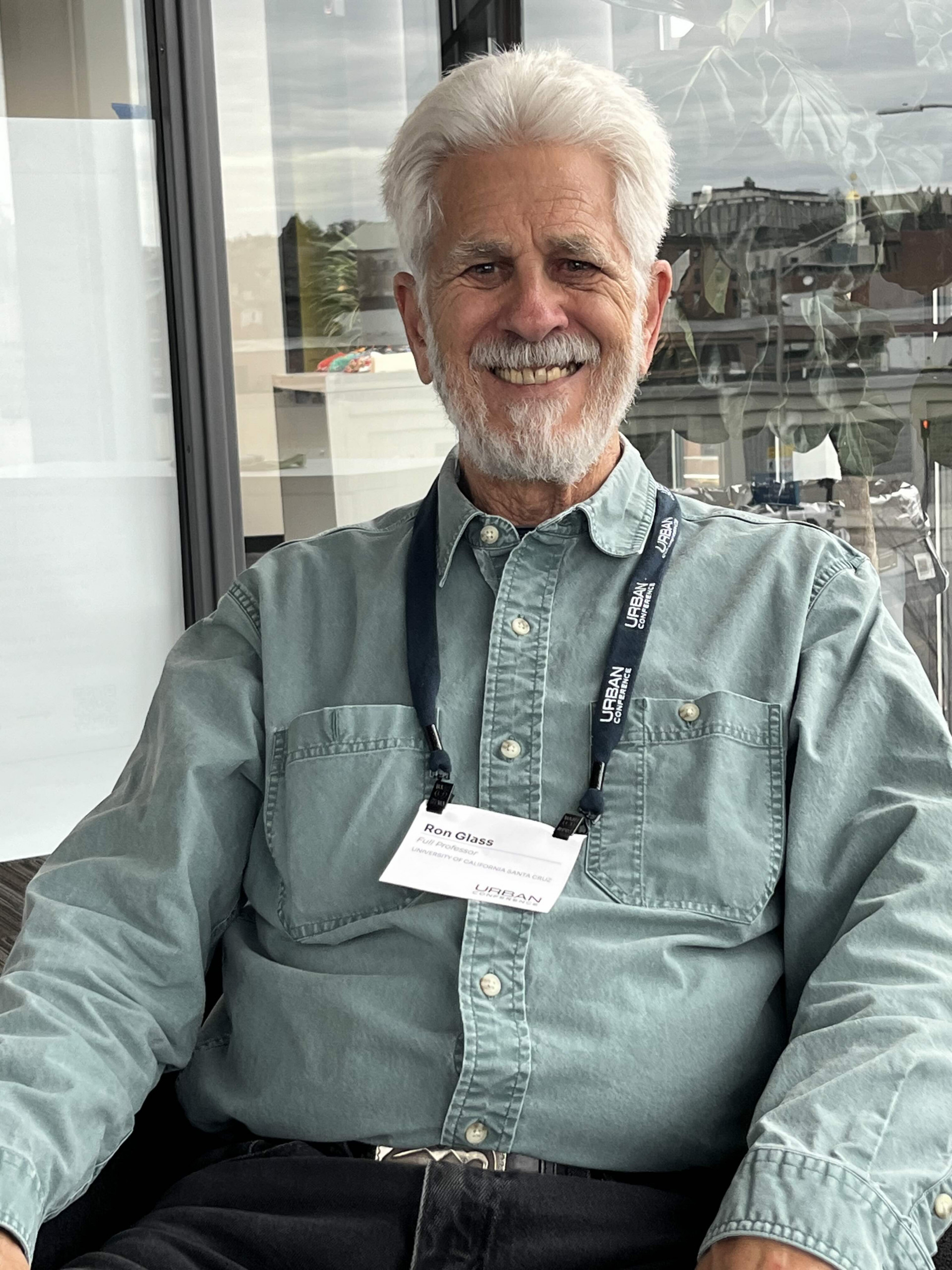
Dr. Ronald David Glass — URBAN Founder, Connector, Strategic Designer, Scholar
In this interview, conducted at the 2025 URBAN National Conference, Dr. Ronald David Glass reflects on his status as an “elder” founder of the URBAN Research Network. He shares insights on the importance of leveraging institutional and relational power for funding and opportunities for community-engaged research and publication, ethics and humility as crucial orientations to the work, and the work’s necessity for commitment to anti-racist, anti-authoritarian, and liberatory action.
JCEC:
Can you tell me a bit about yourself, the work that you do, and how you ended up being connected to the URBAN Research Network?
Ron:
My name is Ronald David Glass. All my publications are in that full name, but everyone calls me Ron. I’ve been part of URBAN since very near its beginning. I had helped to initiate it when I was the Principal Investigator and Director of the University of California system-wide research program initiative called the Center for Collaborative Research for an Equitable California (CCREC) that had faculty members from all the campuses and a number of research centers from the different campuses associated with it. (CCREC was funded out of the office of the president of the University of California, and when a new president found out what we were doing, they cancelled us — sort of like what’s happening now at a national level with research universities).
I was the CCREC director when Mark Warren and Michelle Fine and other folks were putting URBAN together, and Mark and I talked about joining forces while at a meeting in San Francisco. CCREC was already operational when URBAN got formed, and I said to Mark, “You know, we have money. We have funding for five years and we already have quite a bit going on, and I’ll try to help build URBAN.” So, I used some of CCREC’s resources to support some of the early work in URBAN, specifically the first few conferences and staff support to help organize an URBAN node within the American Educational Research Association. I brought groups of scholars and community leaders to the URBAN gatherings, and I also helped organize some of the writing that we did out of those first few conferences. I organized and facilitated the group of scholars that wrote a paper on the ethics of community-based research, and I co-edited a couple of volumes of collected works from the URBAN conferences (published in special editions of Urban Education, and of Education Policy Analysis Archives).
So, I’ve been part of URBAN and URBAN leadership since very near its beginning, and I’m the elder, I guess, of everyone involved that way, and no one will let me quit even though I keep retiring… The leadership keeps including me in the national planning team meetings, so I go to those and I try to support the new generation.
JCEC:
How do you tend to think about collaboration and what kinds of collaborative relationships or practices are you or your organization engaged in?
Ron:
I actually don’t quite know how to answer. I mean, collaboration happens in a whole lot of different ways and depends on people’s disciplinary backgrounds if I think of it from the point of view of the scholars and universities, rather than the community-based people. I’ve seen many, many different types of partnerships. Some of them are very deep, and involve collaboration at deep levels of values and long-term commitments. Others are more shallow and pragmatic, often with near-term or short-term objectives and more limited forms of collaboration. Still, all of those different forms and approaches can be ethical, can be politically powerful, and can contribute to the research literature.
My own background…I call myself a historical-cultural-political-psychoanalyst. I trained mainly as a philosopher, and I was paid by the University of California to be a philosopher of education. I guess my expertise is in designing learning programs or projects where the knowledge that is produced in those projects is not only disseminated, but it is mobilized into action. My role tends to be at the level of pulling people together, holding space for collaborations to happen, and strategic planning or design.
And also, because of my elite university connections, I have played a role in finding money to support this work; funding this work is very, very hard to do, and very few people actually have the connections and status to pull that off. I certainly didn’t have the status and connections before I became the head of CCREC, that University of California system-wide research initiative, but that was such a powerful national position that I could immediately start to have productive conversations with NSF program officers or the presidents of research foundations. As CCREC director, I could call them up and have a conversation, whereas the week before I had that position, that would not have been possible,
Who you collaborate with works differently in different projects, right? You know, when I moved to Santa Cruz and took a position there as a tenured professor, I was not very familiar with the community. I had spent some time in the community 20 years earlier, but in order to learn more, as soon as I got there, I contacted the most prominent radical faculty on the campus and I asked to meet them and take them out to lunch. At lunch, I asked them to tell me their view of the lay of the land. I then went to the big community-based organizations and introduced myself to the executive directors and asked them to lunch, where I said, “Hi, I’m new in town. I’m trying to learn about things. Would you be willing to give me a tour of the community from your point of view?” The executive directors from two different leading community-based organizations were so kind to me; they spent several hours taking me around the community, introducing me to people, explaining the local politics as they saw it. So, I spent that first year in Santa Cruz going around that way and introducing myself and asking people to tell me what they knew about the community.
At the end of that year, I invited to the campus all those people that I had talked to in the community to a day-long session to engage with some of my colleagues from around the world that I had also invited. I and my four colleagues presented examples of our work to the assembled group of people that I had asked for their view of the community. I then said to them, “Now you know more about me and the kind of work I do. Does any of this make sense to you? Are any of you interested in doing something along these lines here?” And I said, “I’m not interested in doing something unless we’re all committed for 10 years. So anyone who isn’t willing to make a ten-year commitment, I’m not interested in partnering with you.” I said, “The issues that we’re dealing with are centuries old – millennial — and so what makes us so arrogant to think that we can overcome them in a year, or two years, or three years or five years — even 10 years, right? So, I’m only interested in partnering with people who will admit that everything we have done up to now has failed, who will admit that we don’t really know what to do, but who are willing to make a long-term commitment to work collaboratively with each other to invent something.”
And so that produced what we called — we never had another name for it – what we called simply, The Project. And several years of work with The Project was what led to CCREC, because I just took its founding ideas to organize interested faculty and research centers at a University of California system level. So, yeah, that’s how I start these collaborations…from a place of recognizing my ignorance and my weakness despite years of effort seeking a more just society, and I try to meet other people who can start there too, and that makes for wonderful partnerships.
JCEC:
Based on your experience, what would you say are some collaboration best practices—particularly in this current context of social upheaval and uncertainty?
Ron:
The advice I give to my students and to Junior Scholars is to ‘be yourself’ and start with a lot of humility, right? I mean, people in the university — even people who come from working class backgrounds — get trained up to think of themselves as experts and know-it-alls. But I think that we always have to begin from a place of humility and recognize how limited what we know is, and how difficult it is to overcome the racism, the sexism, the classism, that obstructs and taints our views, right? Being willing — for white scholars in particular — to understand that we’re racist no matter what, and that our task is to become anti-racist and engage in the work to root those things out in our lives over and over and over again. It is important that we begin from those places, and from places of curiosity where we know that we have a lot to learn about the world and ourselves. And the other thing I think I would say to people is: Don’t just think that your work is about changing the world. It’s also about changing yourself, because all of the problematic issues that are out in the world are also inside each of us in particular ways. If we’re not doing that internal work, then we can’t do a good job at the external stuff. So, I tell everyone, “You have to have a practice of self-realization, and not only for your own development, but to suffer what we have to suffer when we do this work.” I would say that those are some of my starting places with people.
JCEC:
Is there anything you would like to add?
Ron:
I think that this work is becoming more and more important, and we’re seeing it every day. And I think the local level work that you have to do to do collaborative work is going to be what is going to get us through this period of fascism, authoritarianism. I really strongly encourage people…don’t feel defeated by focusing at the local level. That local work is the historical foundation of all liberatory movements.